A Return to the World of More with Less?
By - Bharat Sharma 11:11 pm 25th September 2026
I am sure all of my dear viewers have looked at RAM prices — wide eyes, drooping jaws, wallets clinging on for dear life. While consumers of video games and computer hardware sit with their heads buried in their hands over Steam Deck prices, that same RAM is presumably being used to generate AI cat videos that their mums think are real.
Gone are the days when consoles and memory got cheaper with age. The PS5 is now $1,000 AUD and still houses hardware from six years ago.
This whole situation is unfortunate, sad, and an unreasonable ask of most people. And so what I want to talk about today is something that has not been discussed widely in public since the PS3, which is — how to achieve more with less?
Back in the age of scarcity
My belief is that we are back in the age of scarcity — less RAM, higher prices, and less of it left over for the things you actually bought the device to do. Hence to make the most of it — at least temporarily — we need to write better and more optimised software. Even with reduced RAM offerings — the base Google Pixel 11 Pro starting at 12 GB, down from 16 GB last generation, and more expensive — all we see are bloated, bigger apps, operating systems flooded with feature dumps, and no respect for optimisation (or your phone’s hardware).
I mean, I’m sure a language-learning app does not have to be 850 MB on the App Store if I only get as far as ordering an apple and some bread at a restaurant. There have to be better ways to write that app — especially now, with agentic AI.
The current state of these applications, games and OSs is an effect of what I’d like to call the Unreal Engine Effect, which permeates beyond the gaming industry.
For years, hardware was abundant, so most people stopped caring what it could actually do. They’d dump heavy games and apps onto it, and if those builds started to hurt, newer hardware was already on the horizon — and the machine you already owned was getting cheaper anyway.
The Unreal Engine Effect
The Unreal Engine Effect, to me, is when software people throw everything they have at the hardware and hope it will just work. We have seen it again and again. Steam-library games with insane requirements become unplayable on the average machine, which is now the case with most AAA titles. We all know the feeling of waiting years for a game, only for the recommended spec to read 32 GB of RAM and an RTX 5090. What’s funnier is that those recommendations are still written as if we live in pre-2025 times — times when hardware got cheaper the longer you waited.
The spike in prices has made it extremely hard for the average consumer to upgrade to new hardware. In the smartphone and VR markets the ask is even funnier. You are expected to pay a lot of extra money for slightly incremental performance from the previous generation, while the apps being dumped onto these systems continue to disregard optimisation in every way.
VR has jumped insanely high. Meta raised the Quest 3 to $600 (from $499) and the Quest 3S to $350 / $450, citing memory chips. Valve delayed Steam Frame over the same shortage, then shipped it at $1,059 USD — $1,609 AUD — for the 256 GB model, or $1,299 / $1,969 AUD for the 1 TB. Meta’s Ray-Ban Display glasses start at $799. Meanwhile these platforms have such poor game and application libraries that they haven’t been updated in years.
The best VR games that exist are still from years ago. Since the metaverse’s spiritual downfall, almost nobody has cared enough to update those libraries in a serious way — not since 2021.
Hardware prices are here to stay
But all of this so far has been a rant. You might be asking — so what can devs do to avoid this? The answer is simple yet complex. First of all: hardware prices are here to stay.
I did not want to just gesture at “the news” here. I sat down and rebuilt the memory market from published numbers — street kit prices, TrendForce contract moves, IDC’s wafer story, the device stickers we actually pay in Australia — and drew the charts from that raw series. Nothing below is a graph lifted off Twitter.
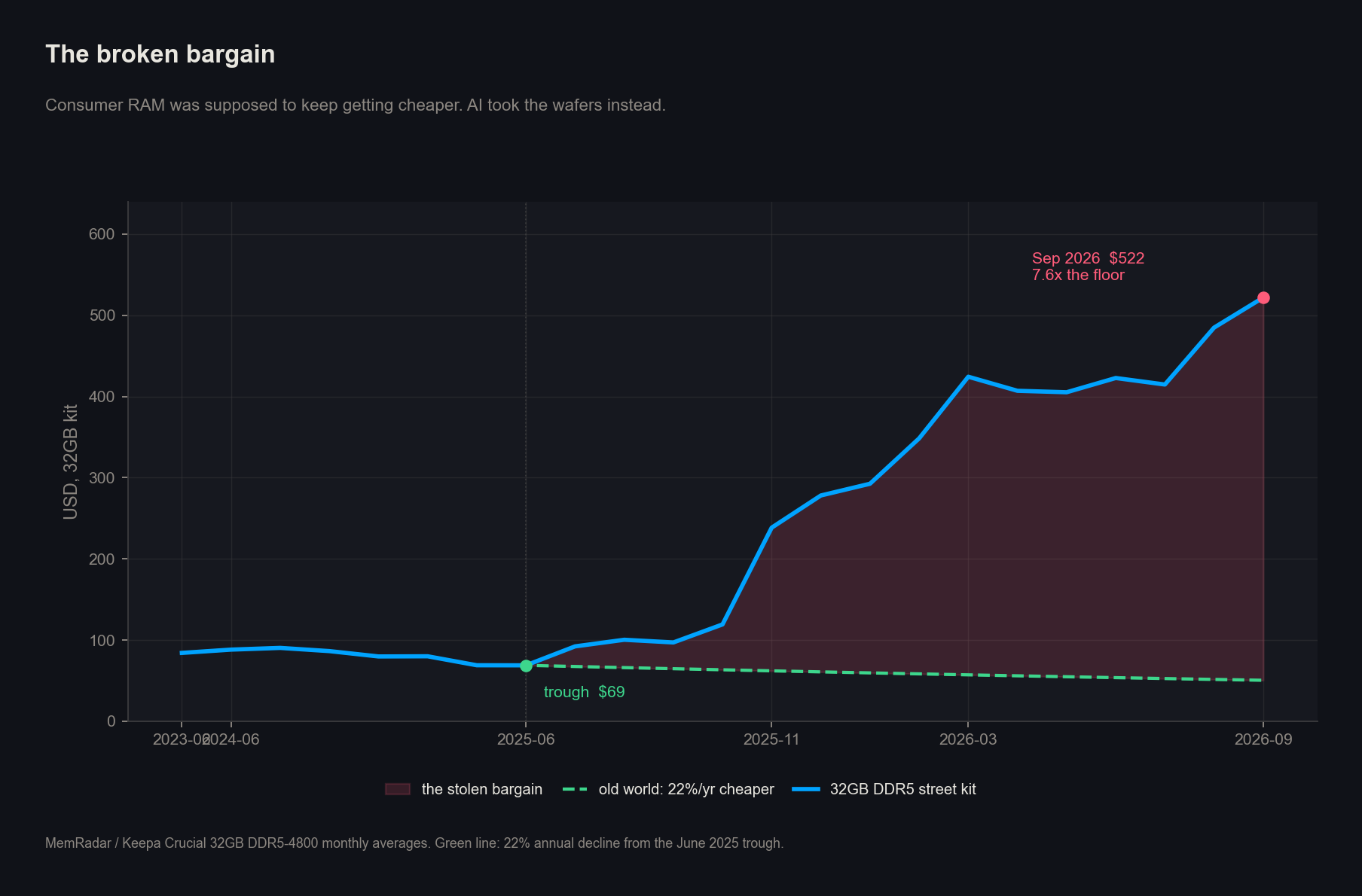
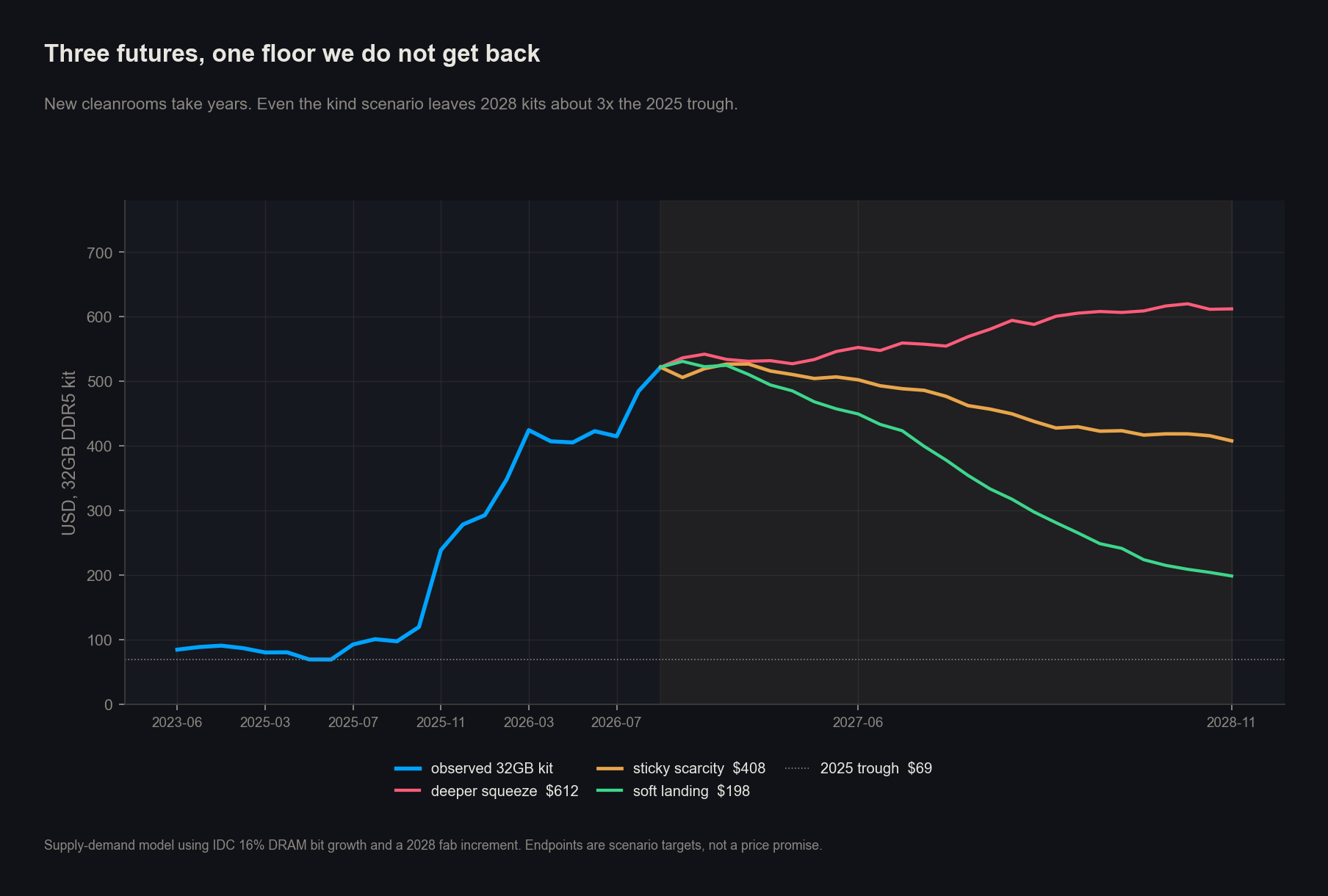
A 32 GB DDR5 kit bottomed at $69 in June 2025. In September 2026 the same class of kit sits around $522. That is 7.6× the floor in fifteen months. If the old DRAM bargain had kept going — memory getting roughly 22% cheaper every year, the deal we all grew up on — that kit would be about $50 today. We are living in a world that is ten times more expensive than the one the industry promised us.
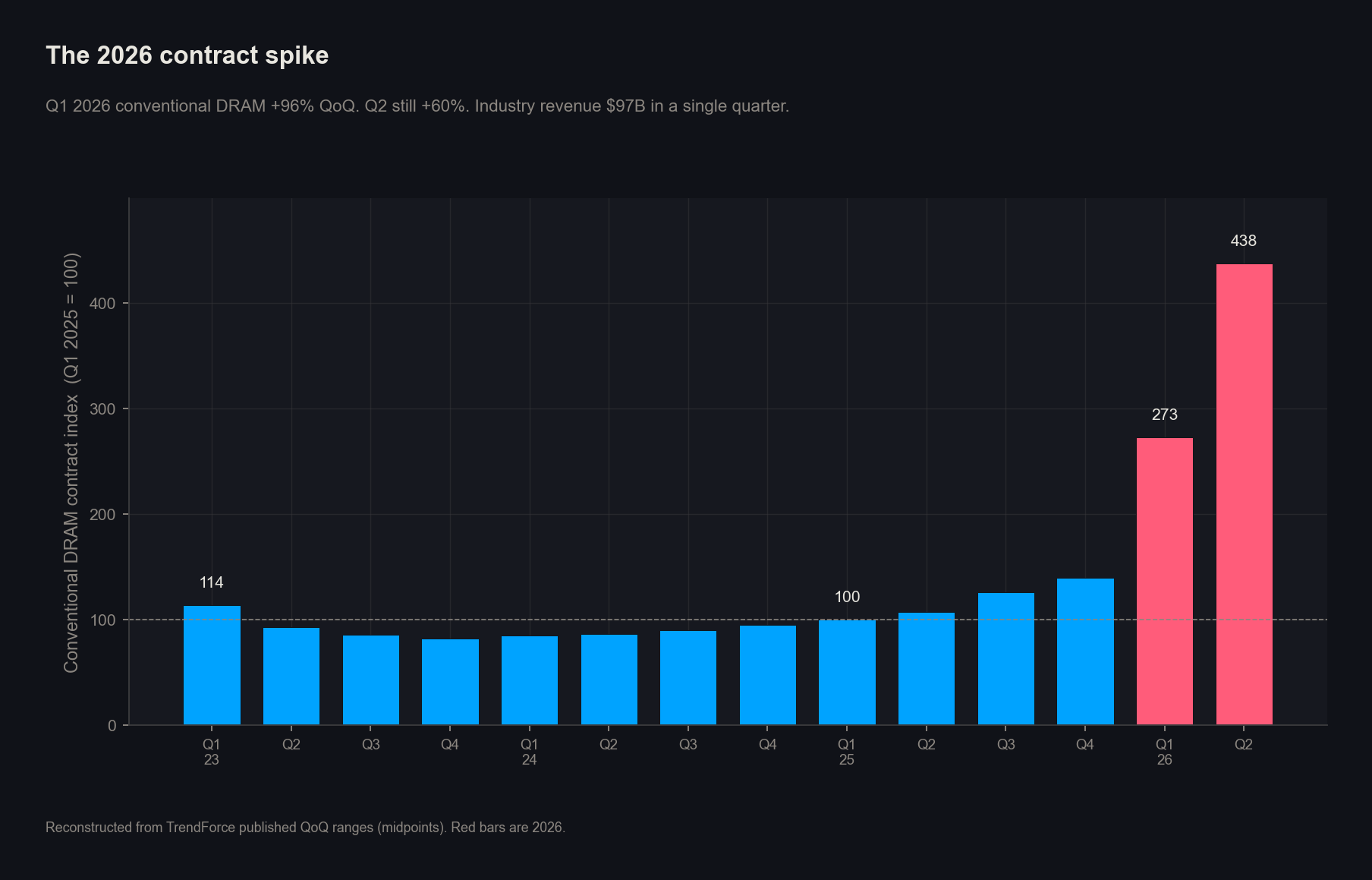
Upstream, the contract market is even ruder. TrendForce put conventional DRAM +93–98% quarter-on-quarter in Q1 2026, then called +58–63% for Q2. The industry printed $97 billion in a single quarter, up 81% QoQ — not because the Big Three magically made more consumer RAM, but because they charged everyone as if they were a hyperscaler. From Q1 2025 the contract index has more than quadrupled.
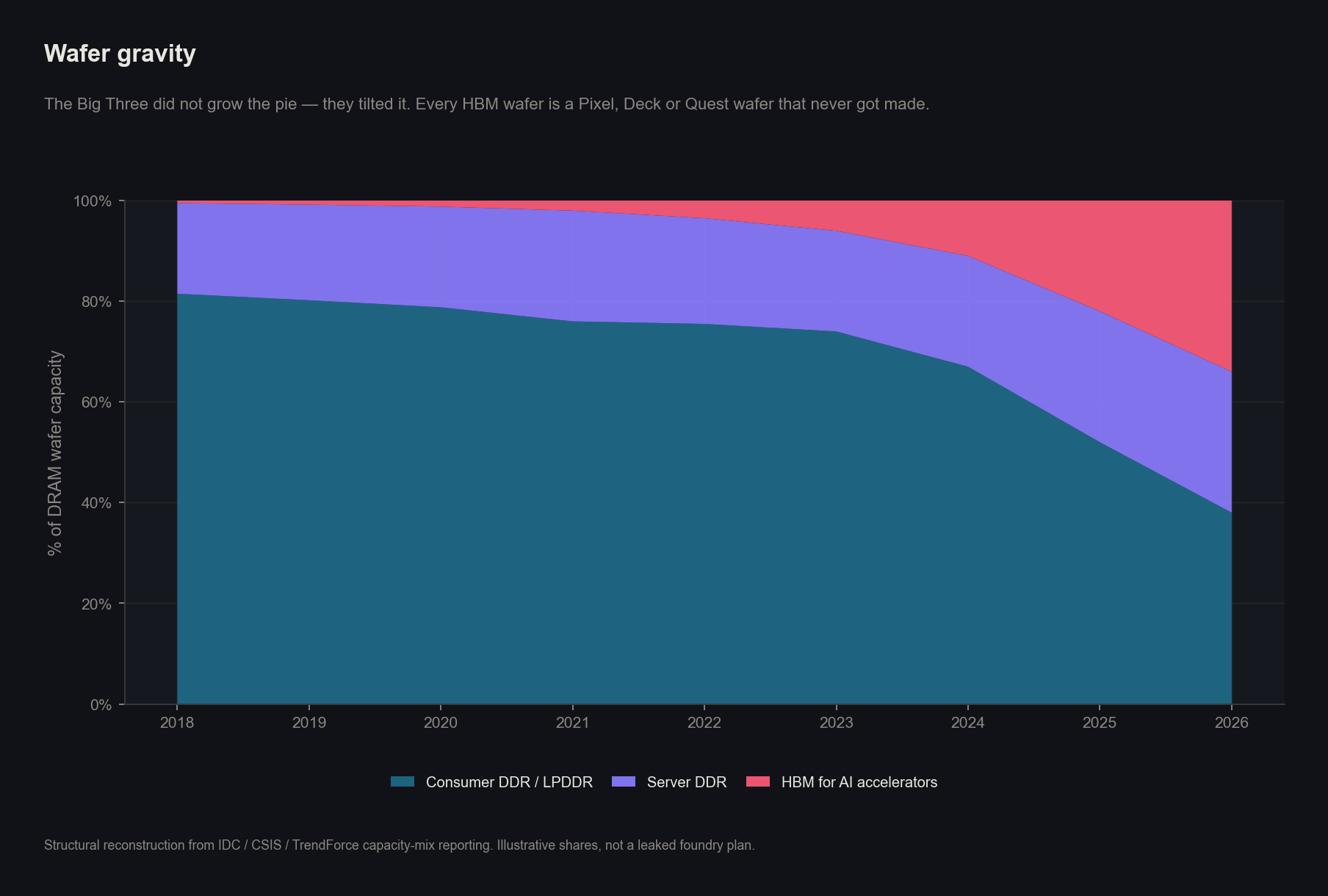
IDC’s line is the one that matters for whether this unsticks. They called 2026 DRAM bit growth 16% — below the historical norm — and said this is not a normal cycle. It is a zero-sum reallocation of cleanroom. Every wafer that becomes an HBM stack for an Nvidia GPU is a wafer that does not become LPDDR in a Pixel or a Steam Deck. I reconstructed that mix over time. Consumer’s share of the wafer pie is the thing that is shrinking.
That is why the stickers on things you actually want have gone the wrong way.
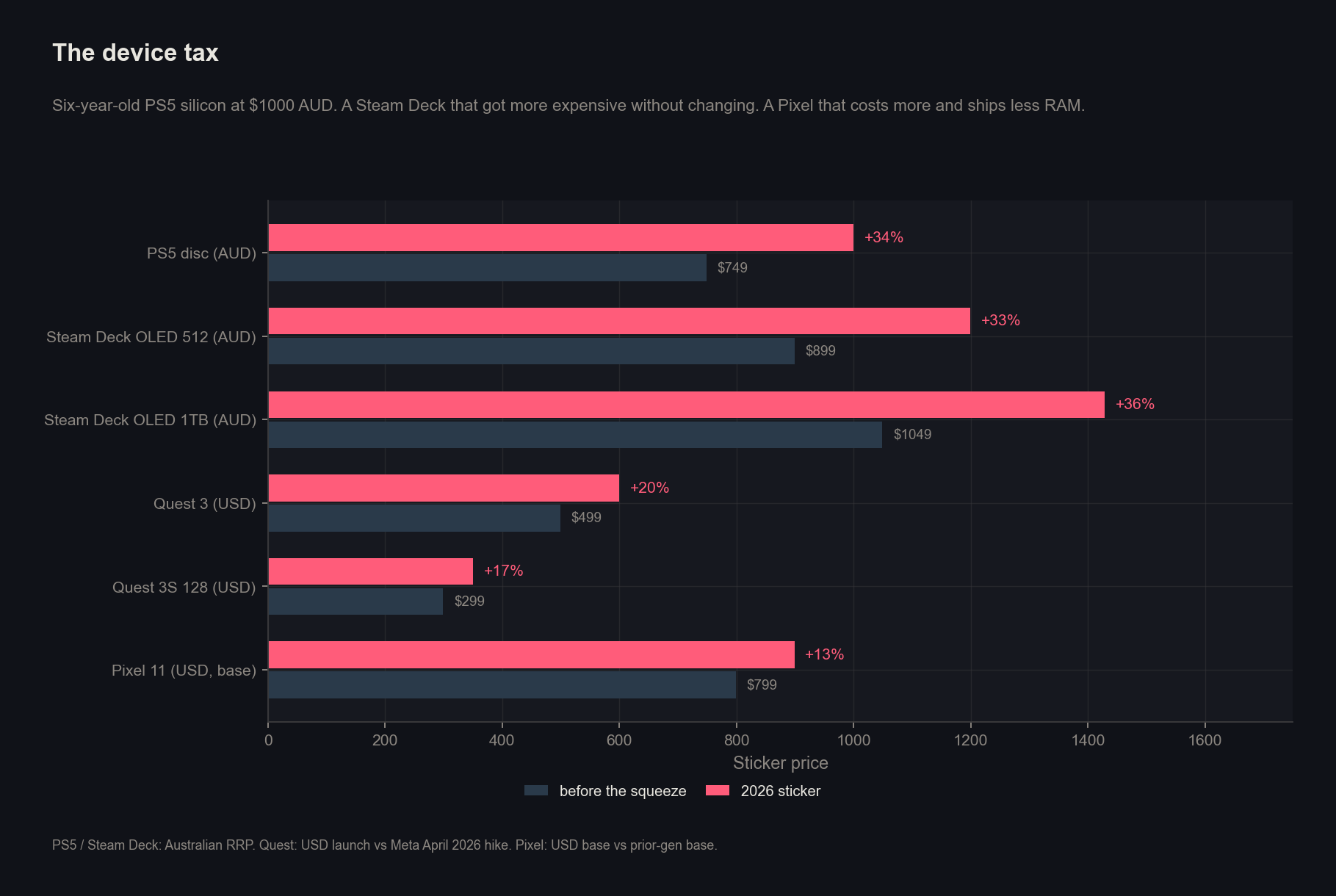
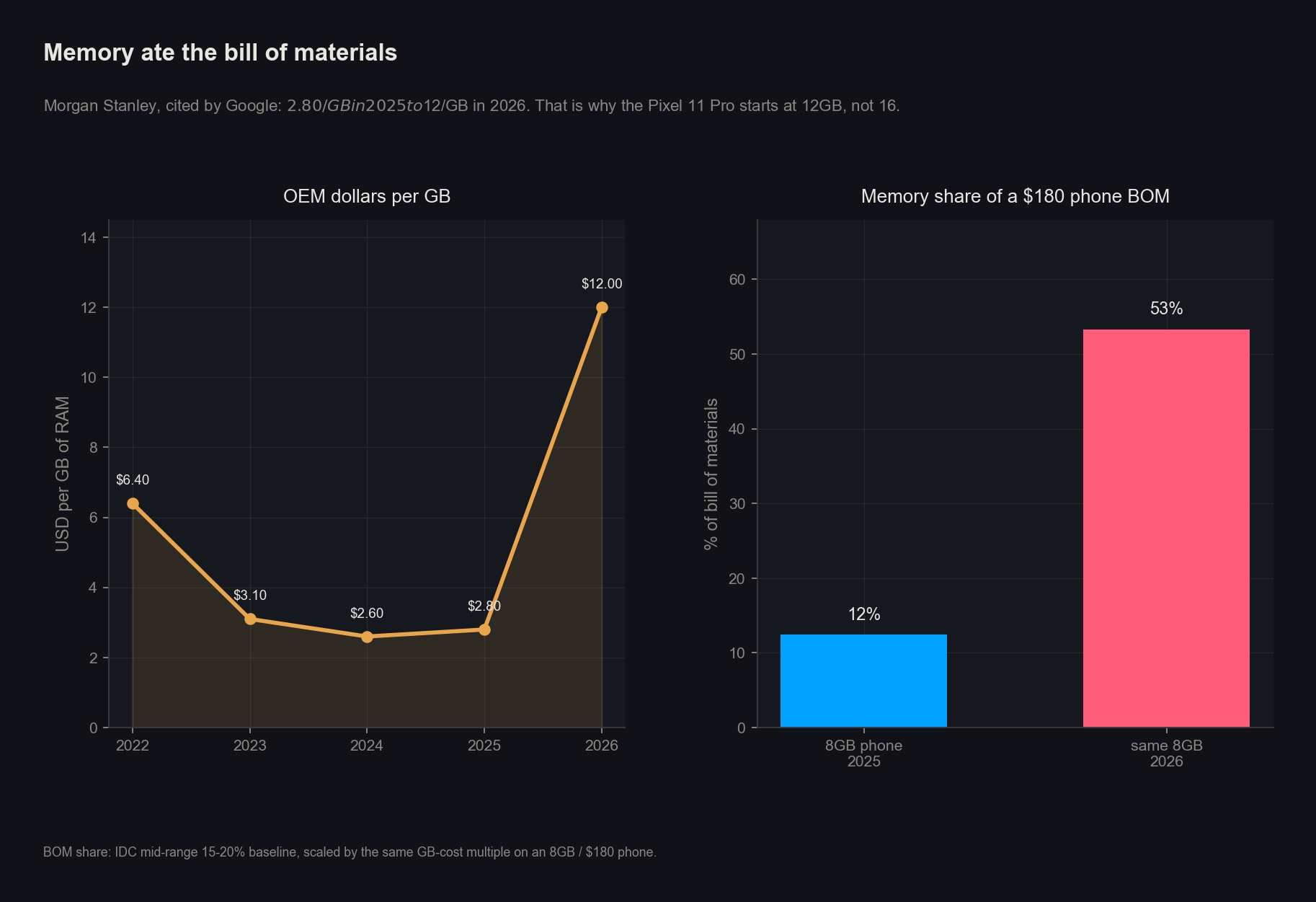
Google’s own briefing on the Pixel 11 Pro cited Morgan Stanley: $2.80 per GB of RAM in 2025, $12 in 2026. A 4.3× component. On an ordinary mid-range phone that used to spend maybe 12% of its bill of materials on memory, keeping 8 GB at 2026 prices would let RAM eat half the BOM. That is why the Pro starts at 12 GB. That is why Valve hiked a Deck that did not change. That is why a six-year-old PS5 is a thousand dollars.
So is it “here to stay”? I ran three futures from September 2026 through the end of 2028. Same supply story — IDC’s slow bit growth, HBM still climbing, a delayed fab increment in 2028, because new cleanrooms take years. The scenarios only disagree on how hungry inference DDR5 stays.
- Deeper squeeze — inference keeps eating conventional DDR5. Kits around $610 by late 2028.
- Sticky scarcity — the base case. Prices ease a little and sit near $410. Still six times the 2025 trough.
- Soft landing — the kind one. New capacity finally shows up. Kits around $200. Still about three times the trough.
None of them give us $69 back. Not by 2028.
That is the technical conclusion I wanted. Hardware prices are not a vibe. They are a wafer allocation, a multi-year fab lag, and a customer — the data centre — that will pay first. The old social contract of “wait a year, it gets cheaper” is broken. We should stop writing software as if it isn’t.
Start caring about good code again
But what devs can do is start caring about good code again. Even if more of the coding gets automated, that does not remove the need to optimise. In fact the current hardware crisis, I believe, demands that our applications are better optimised. Consumer apps need to start caring about running on as little as possible, so the person on the other side stays happy and comes back. Bloated adware baked into an app will get that app nowhere — at least if you are a smaller company.
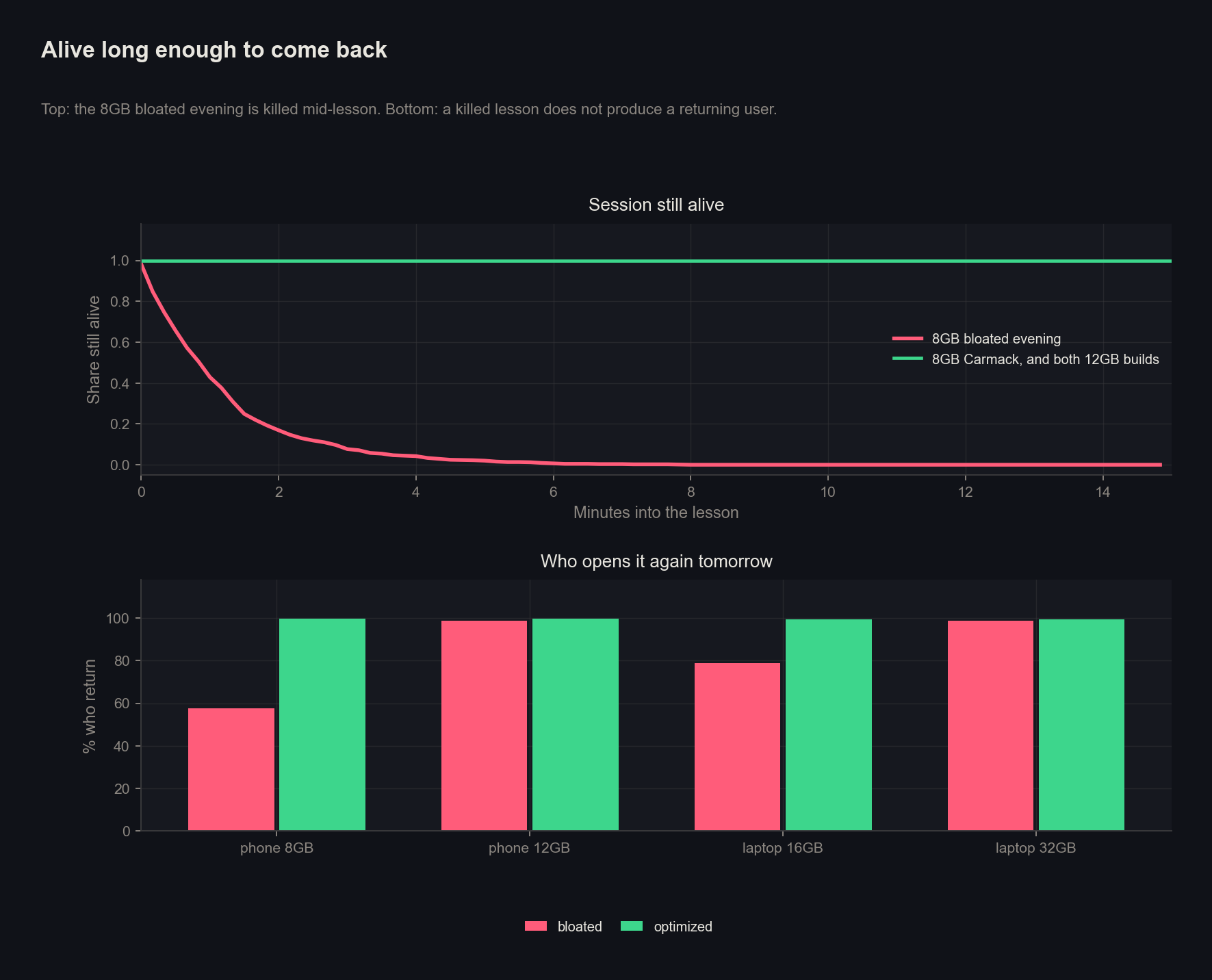
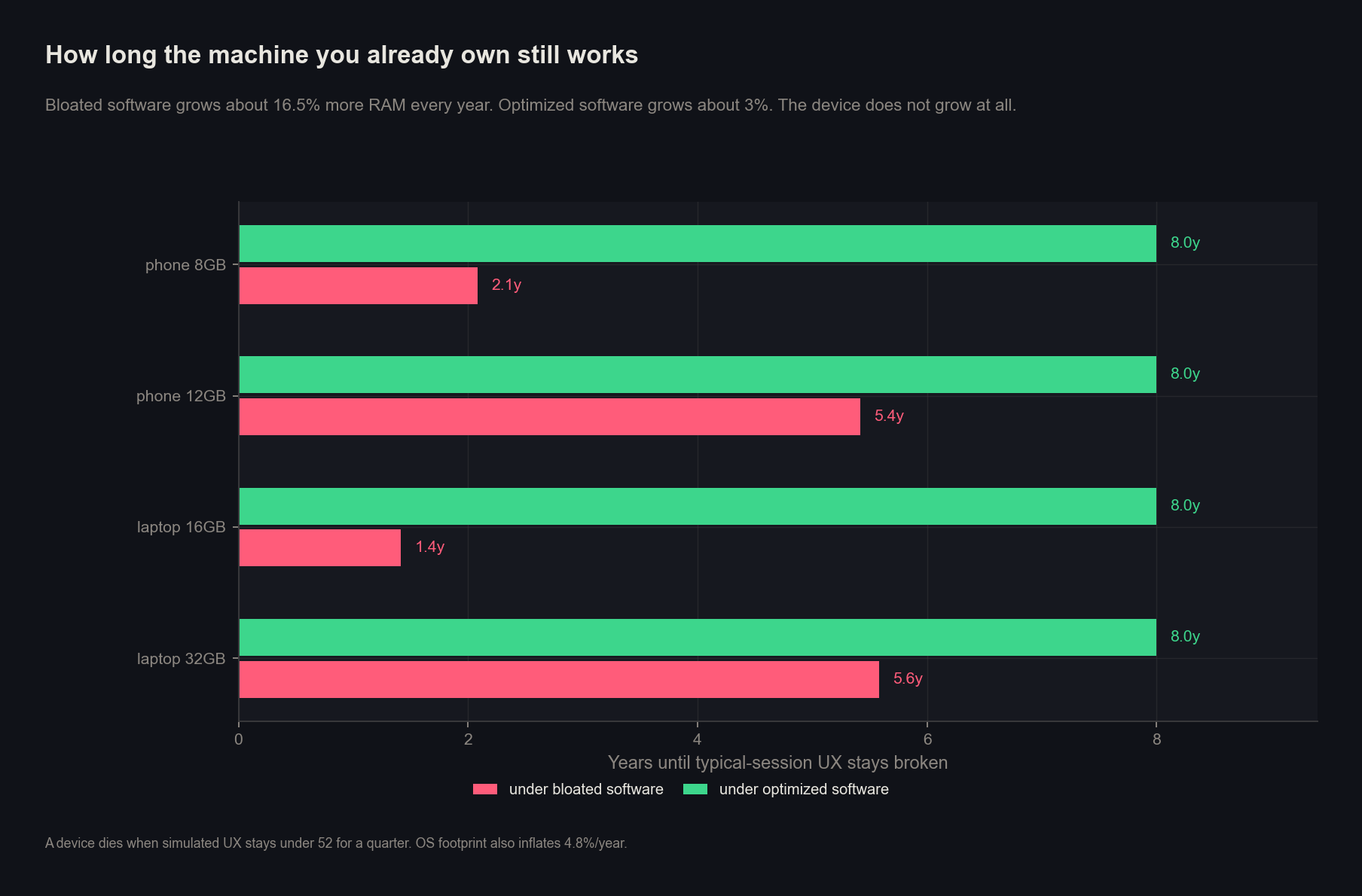
I wanted numbers on that claim, not just a sermon. So I ran a second block of analysis: a Monte Carlo of 900 sessions × 15 minutes, then an eight-year aging model where bloated software keeps growing at about 16.5% more RAM a year (feature dumps, leftover packs, another SDK) and Carmack-budget software grows at about 3%. This is a model, not a lab benchmark — calibrated to published working sets, Android-style jetsam, and the kind of memory budgets id and Team Silent used to treat as religion. The point is the gap, and the gap is not small.
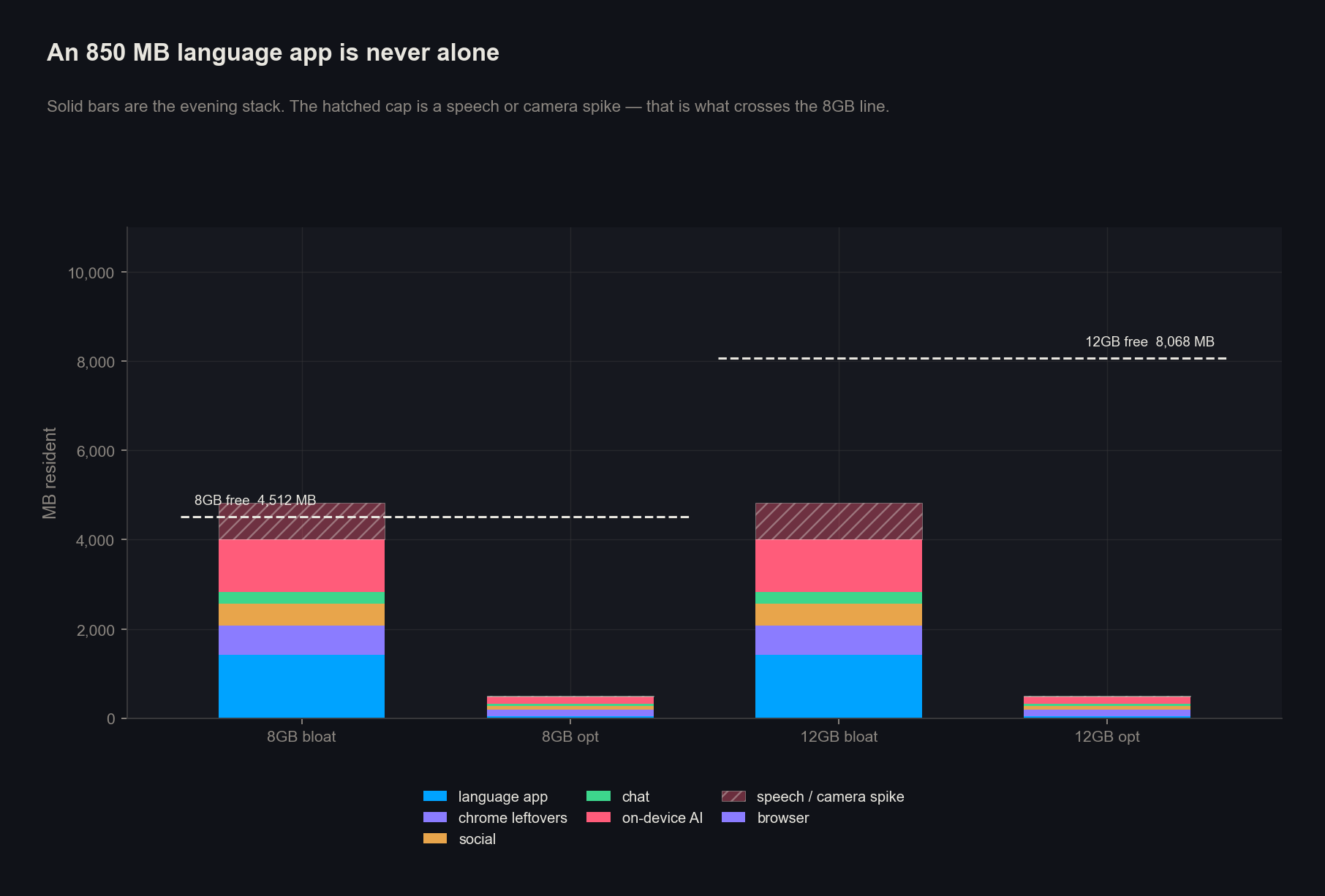
I put a specific language-learning evening on an 8 GB phone and a 12 GB phone. Not the 850 MB App Store listing sitting alone in a vacuum — that listing is never alone. The bloated evening is the language client plus leftover Chrome, a social app, chat, and an on-device AI pack: about 4,000 MB resident against 4,512 MB free on an 8 GB phone after the OS. The Carmack evening is a native, incremental client with no ad-SDK forest: about 479 MB.
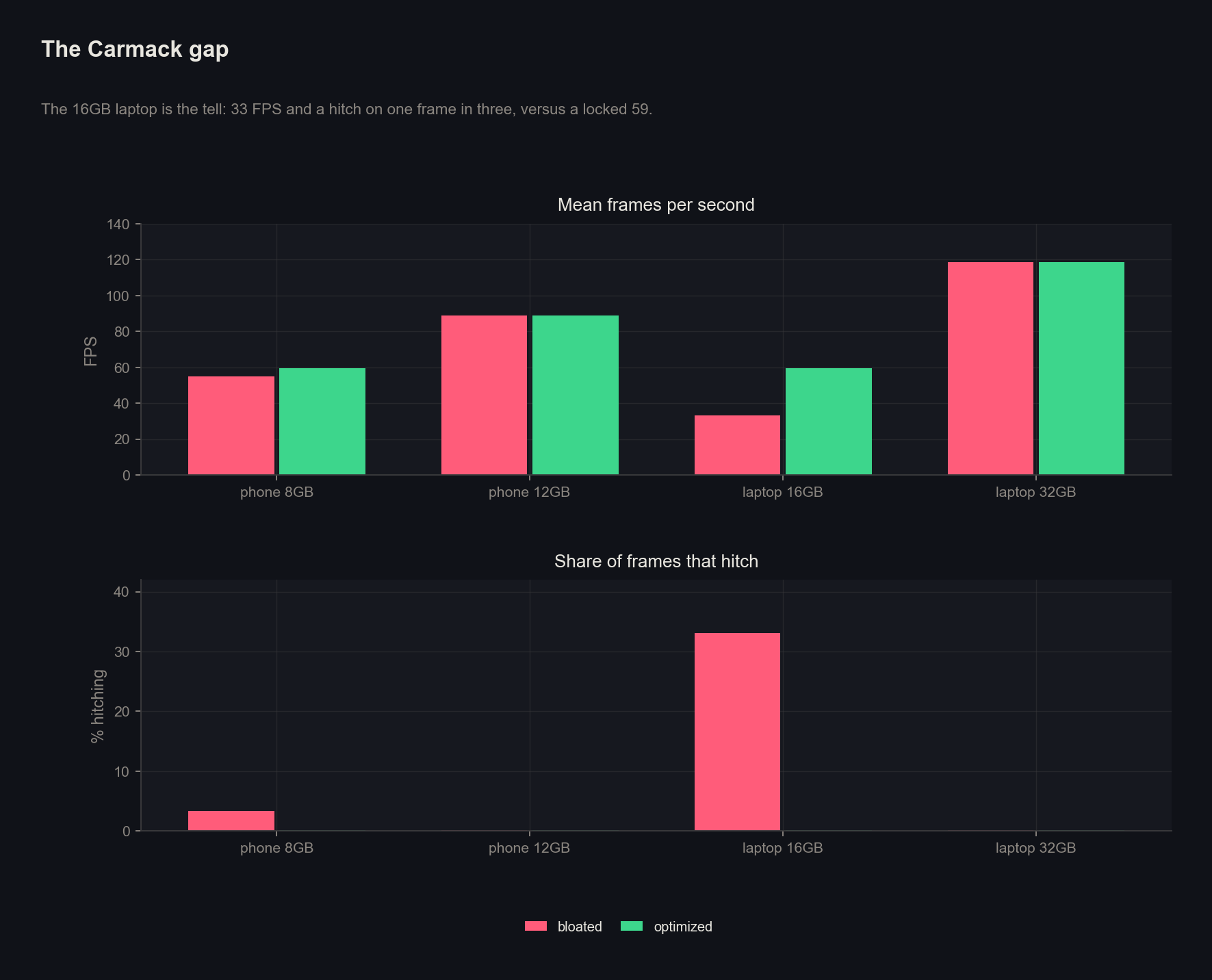
Then I put a 3D title on a 16 GB laptop and a 32 GB laptop. Unreal-class working set around 14 GB, versus an id / Team Silent budget around 3.4 GB.
Same hardware. Same session. The only variable is whether the software was written like it had to fit.
On the 8 GB phone, the bloated evening is not “a bit janky.” In the model it is killed in 100% of sessions. Mean UX is 62. About 58% of people open it again tomorrow. The Carmack evening is never killed, finishes every lesson, and 99.7% come back. That is not a polish difference. That is the difference between a product and a crash with a mascot.
On the 12 GB phone — the Pixel 11 Pro’s new base — today’s bloated evening still finishes. The extra 4 GB is a buffer. It buys you the present. It does not buy you the future. Leave the stack growing at 16.5% a year and that 12 GB phone falls under the broken-UX line in about 5.4 years. The optimised stack is still fine at year eight.
On the 16 GB laptop, the Unreal-class title averages 33 FPS with a hitch on one frame in three. Pressure is 1.5 — it is paging for a living. The Team Silent budget locks 59 FPS, hitching on 0.16% of frames. That is a 79% frame-rate lift and a couple of hundred times less jank. Clean finish rate goes from 0% to 100%. Return-tomorrow goes from 79% to 99.5%.
The 32 GB laptop is the RTX 5090 recommendation in laptop form. It hides the crime today. Both builds look fine in a fifteen-minute session. Give the bloated title a few years of feature dumps and that machine dies at 5.6 years. The tight budget does not.
And this is the part I keep coming back to, because it is the only upgrade most people can still afford.
Like early video games — Doom in a few megabytes, Silent Hill 2 in the 32 MB of a PlayStation 2 — writing with care for memory does not just make a nicer frame time. It makes the phone you already have last. It makes the laptop you cannot replace this year still feel like a computer. It makes the user come back. And it makes the person who wrote it give a damn about the machine again.
We are virtually back in 1999
Like it or not, we are virtually back in the age of scarce and expensive hardware. That is the world in which computers cost a fortune, and the makers of games and apps had to honour those limits in every line of code. Those limits are not back in the old absolute sense — we are not compiling Doom into 8 MB — but the ability to just buy more electronics, to keep up with apps that grow without asking, has certainly gotten more limited.
Writing tighter software is no longer a nice-to-have. It is necessary again. Consumers get systems that still feel like systems. Makers get people who stay. Think of indie games that still run on a machine from ten years ago. That is what this can look like.
I think the shift could grow a generation of programmers who actually care about their computers again — hardware limits, memory, optimisation. The mood on X is doom and gloom. I do not buy it. Pair automated coding with real systems knowledge — agentic AI and a language like Rust — and you get a combination the industry has not really had: the beginning of systems programming, on steroids.
I am keen to see where this goes. I will follow it in my own work as a dev and a data engineer, and I may come back in a few months with what I have learned.
And I could not agree more with DHH on his second Lex Fridman appearance. I will paraphrase him: despite the fearmongering, nobody can tell you what comes next, so we might as well live in the present, stay excited about the tools we have, and use capabilities no generation before us had — to win and dominate in our own lives.
Reply to this post
Subscribe and the next piece lands in your inbox. Comments live on Substack — that is the conversation layer for these posts.
Leave a comment